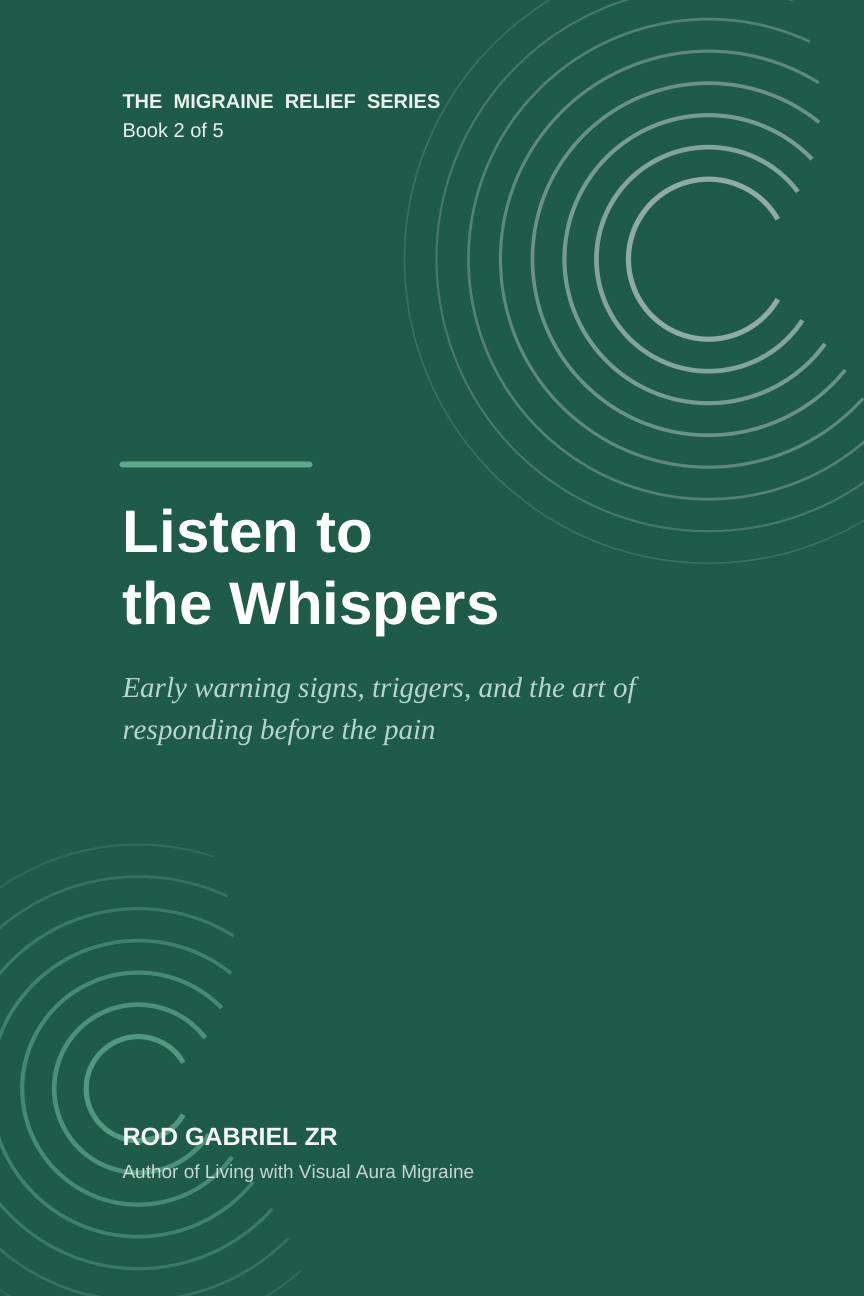
About the book
Your body warns you long before the pain arrives — if you know how to listen. Learn to read your earliest signals and act in the fifteen minutes that can change how an entire attack unfolds.
What you'll take away
- Migraine usually whispers before it shouts — learning your earliest signals buys you time.
- Knowing your triggers by name turns vague dread into something you can act on.
- The first fifteen minutes after a warning sign are when a calm, practiced response matters most.
- Building a sensory sanctuary and owning your migraine story shifts you from reacting to responding.
Start reading — free preview
As I write this, I can feel the subtle shift of awareness in my own body — that whisper of change that signals a storm gathering on the horizon. These early warnings, so easily missed in the rush of daily life, are precious messengers. They offer a chance to intervene before pain claims center stage.
For years I missed them completely. I only heard the shouts: the shimmer, the blind spot, the pounding. This book is about learning to hear the whispers instead — and about the small, calm sequence of responses I now run almost on autopilot when they arrive. One promise before we start: this is not about becoming “the migraine person.”
My goal has never been to center my life on this condition, but to build a safety net so seamless that using it barely takes a thought. When my mood shifts unexpectedly, or the world takes on a peculiar off-kilter quality, my extraordinary but sometimes temperamental brain is sending early distress signals. These are not inconveniences.
They are invitations to deeper awareness — opportunities to respond while there is still time to change the outcome. My own whispers took months to identify, because they hide inside ordinary life. A jaw clenched tight enough to crack nuts. Shoulders creeping toward my ears.
Thoughts racing from worry to worry like a pinball machine. Yawning. Irritability out of proportion to anything happening. A vague “off” feeling with no name. Sensitivity to a light that yesterday seemed perfectly normal. The signs were always there, long before the visual disturbance announced itself.
I just hadn’t learned how to listen. Map your whispers — a worksheet □ In the hours before your last few episodes, what changed in your body? (jaw, neck, shoulders, stomach, energy) □ What changed in your mood?
(irritable, weepy, wired, foggy, strangely euphoric) □ What changed in your senses? (light, sound, smell suddenly “too much”) □ What changed in your behavior? (skipping water, holding your breath, hunching at a screen) Through long trial and error, I discovered mine: excessive caffeine, prolonged screen time, dehydration, stress — and, most surprisingly, my own breathing patterns.
During stressful situations, my rapid, shallow breathing created a state of mild oxygen shortage that often preceded my visual disturbances. Heat and harsh light joined the list. So did poor sleep — I learned that lesson the hard way on a beach vacation, after two nights of my relatives’ snoring symphony, a merciless sun, and a forgotten water bottle.
The episode that followed was one of my most intense. Your list will look different. That’s the point. Triggers are personal, and they usually work in combination: caffeine alone might be fine, but caffeine on four hours of sleep in bright heat is a loaded spring.
What matters is moving from a vague sense of “sometimes things set me off” to a short, specific, written list you actually know by heart. Common trigger families to investigate Fuel: dehydration, skipped meals, caffeine spikes and crashes, alcohol. Load: stress, arguments, deadlines, held breath, clenched muscles.
Input: screens, glare, flicker, fluorescent light, noise, strong smells. Rhythm: poor sleep, oversleeping, jet lag, hormonal shifts, weather and heat. There is wisdom in reaching for nourishment the moment the whispers begin. For me, that means half a banana with a handful of nuts — steady glucose without the dangerous surge and crash.
And water, that most elemental of substances, becomes medicine at this juncture: a tall glass, around half a liter, ideally with electrolytes, flowing through vessels that may already be constricting in preparation for pain. Then comes my five-minute “rescue calm.” That rush of I can’t handle this isn’t failure; it’s biology — stress hormones surging exactly when I need steadiness.
So I give my body the opposite signal: box breathing to draw me back to presence, then a slow body scan, releasing the jaw, the shoulders, the hands. 1. Fuel — a small steady snack: half a banana and a handful of nuts. 2. Water — about 500 ml, with electrolytes if you have them.
- Rescue calm — 2 minutes of box breathing (4–4–4–4), then a 3-minute body scan, jaw and shoulders first. 4. Shield — dark glasses, quieter space, screen down or brightness low. 5. Move gently — a short walk in shade or easy stretches, never anything that spikes your heart rate.
For those who walk this path with prescribed allies — whatever your doctor has given you for attacks — timing becomes everything. Both science and experience taught me the same lesson: medicine taken early, at the whisper stage, works with your body’s own defenses instead of struggling against a fully awakened storm. Talk with your doctor about your early-treatment plan so you know exactly what to do before you need to do it.
My three most reliable early warning signs are… The trigger combination that most often precedes my episodes is… Perhaps the most protective habit I’ve built is the sensory sanctuary: dark glasses shielding sensitive eyes, noise-dampening earbuds creating a buffer between my vulnerable nervous system and a world that suddenly feels too loud, too bright, too much.
These are not mere comfort measures. When my brain enters its hypersensitive state, every reduced input is one less log on the fire. I keep a small kit in my bag — sunglasses, earbuds, a soft snack, an electrolyte sachet — so the sanctuary travels with me. On trains, in offices, at family parties: the storm may still come, but it arrives in a quieter room.
Movement, too, becomes medicine at this stage — a gentle walk in dappled shade, mindful stretches that honor the body’s need for flow without triggering more stress. Not exercise in the conventional sense; more like an embodied way of processing the anxious energy these neural events carry with them. As I track these experiences — noting the time, the emotional texture, the physical sensations — I create not just data but narrative.
A free preview of the book's own opening chapter — scroll to read. The book continues from here.
Get the book
PDF download. After payment, access is added to your Migrainers account shortly — sign in or create an account (use the same email as your PayPal if you can).