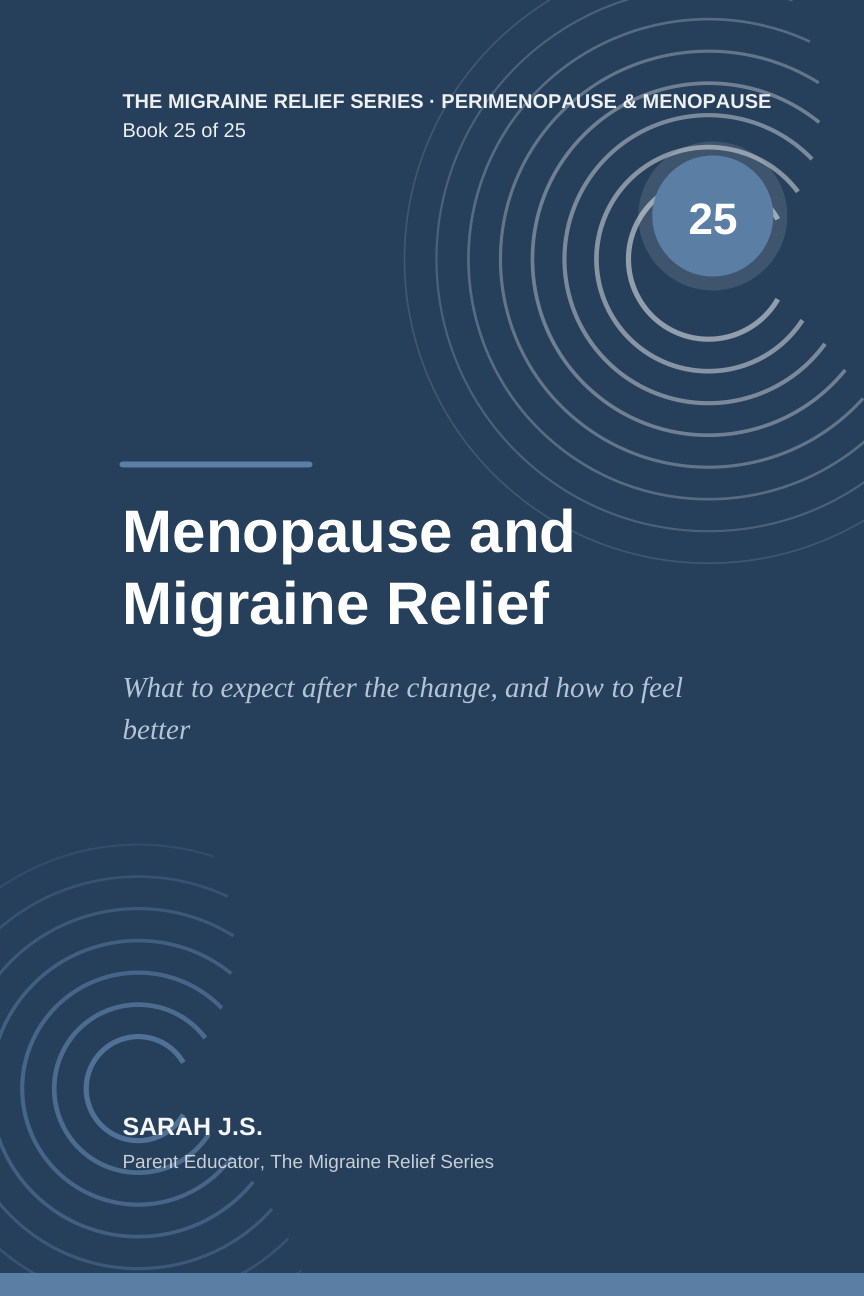
About the book
For many women, menopause finally brings relief — and this is your honest guide to what comes next. What to expect, why it varies, and clear-eyed education on hormone therapy and migraine.
What you'll take away
- For many women, menopause finally brings real relief.
- Migraine can also continue or begin anew — and that is worth understanding.
- Hormone therapy here is a general education, not a one-size recommendation.
- Long-term lifestyle maintenance supports a life beyond the hormonal storm.
Start reading — free preview
This is the closing book of the Hormones & Migraine collection, and it carries genuinely good news for many readers: for a significant number of women, migraine improves substantially after menopause, once hormones settle into their new, stable, low baseline. The fluctuation that made perimenopause so hard is, at this stage, largely behind you. That said, this isn’t everyone’s story, and this book is honest about both paths: the relief many women find, and the real experience of those whose migraine continues or even begins anew after menopause.
Both deserve a place in these pages. Once menopause is complete — generally defined as twelve full months without a period — estrogen settles at a new, low, and importantly stable baseline. Because so much hormonal migraine is driven by fluctuation rather than any particular hormone level on its own, removing the fluctuation entirely brings real relief to a substantial share of women, particularly those whose migraine was clearly tied to their menstrual cycle throughout their reproductive years.
For many women whose migraine tracked closely with their cycle, menopause brings the quietest stretch their migraine history has seen in decades. If this describes your experience, there’s no need to brace for a return of symptoms out of old habit. You’re allowed to simply enjoy the relief.
This isn’t the whole story for every woman, and if your migraine has continued after menopause, or even started for the first time around this stage, that experience is real and medically recognized too — not a sign that something unusual or alarming is happening, though any new headache pattern in this age range is always worth a proper medical evaluation to rule out other causes. If migraine continues or begins around menopause Continue the tracking habits from earlier in this series — patterns are still worth finding, even without a monthly cycle to anchor them to. Non-hormonal triggers — sleep, stress, dehydration, certain foods — often take on relatively more importance once cyclical hormonal triggers fade.
New headache patterns after menopause deserve a proper medical evaluation, both to rule out other causes and to build an effective treatment plan. How has my migraine pattern changed since menopause, if at all? One thing I want to bring up at my next doctor’s visit…
Menopausal hormone therapy is a genuinely personal, individualized medical decision, weighed against your full health history — migraine included, aura status included. Some women find it helps their migraine; others find certain formulations can worsen it, particularly if levels fluctuate rather than staying steady. There’s no universal answer here, which is exactly why it belongs in a conversation with your doctor rather than in a chapter of general advice.
Questions worth raising if you’re considering it “Given my migraine history, and whether I experience aura, is hormone therapy something you’d consider for me?” “If we try it, what formulation and delivery method might be gentlest on migraine specifically?” “What would we watch for in the first few months to know whether it’s helping or hurting my migraine pattern?”
“What are the non-hormonal options, if we decide this isn’t the right path for me?” This book explains general patterns in hormonal migraine for education only. Decisions about contraception, pregnancy, fertility treatment, or hormone therapy should always be made with your own doctor, who knows your full medical history — including whether you experience migraine with aura, which changes some of these conversations.
Whether menopause brought you relief, continuation, or a new onset of migraine, the foundational practices throughout this series remain the steady ground beneath whatever your hormonal chapter looks like now. still one of the most powerful levers available to you at any hormonal stage. movement — see Moving Again — which supports both migraine management and long-term health more broadly at this life stage.
practices, since non-hormonal triggers often become relatively more influential now. since this stage of life carries its own broader health considerations worth staying ahead of. Whatever chapter you’re in — relief, continuation, or something new — you’ve spent decades learning your own body through cycles, pregnancies perhaps, years of unpredictable hormonal weather.
That knowledge doesn’t disappear at menopause. It becomes the foundation for whatever comes next, carried forward rather than left behind. The Identity Series elsewhere in this collection speaks to becoming more than any single condition, hormonal or otherwise. That applies here too: you are not your hormones, any more than you are your migraines.
You are the person who has navigated both, with growing wisdom, for a very long time — and that wisdom is yours to keep, at every stage still ahead. You are not your hormones, any more than you are your migraines. You are the person who has navigated both, with growing wisdom, for a very long time.
This closes the Hormones & Migraine collection, and with it, the full twenty-five-book Migraine Relief Series. Wherever you’re reading from — a first diagnosis, a hard perimenopausal season, or hard-won relief on the other side of it — thank you for letting these pages walk alongside you. You were never meant to do this alone, and now, hopefully, you don’t have to.
Real help, real community, and real understanding are exactly what this whole series was built to offer. This completes The Migraine Relief Series, all twenty-five books. For the memoir at its heart, find Sarah J.S. is a parent educator who has spent years helping families understand and live alongside migraine and other invisible conditions in children.
Drawing on the practices explored throughout the Migraine Relief Series — the breathing, the sensory sanctuaries, the gentle listening to the body’s whispers — she translates them for parents, caregivers, and the kids who trust them most. She writes so that no exhausted parent, sitting on the edge of a child’s bed in the middle of the night, ever has to feel like they’re figuring this out completely alone. You are not alone here.
Real, practical help is exactly what these pages are for.
A free preview of the book's own opening chapter — scroll to read. The book continues from here.
Get the book
PDF download. After payment, access is added to your Migrainers account shortly — sign in or create an account (use the same email as your PayPal if you can).